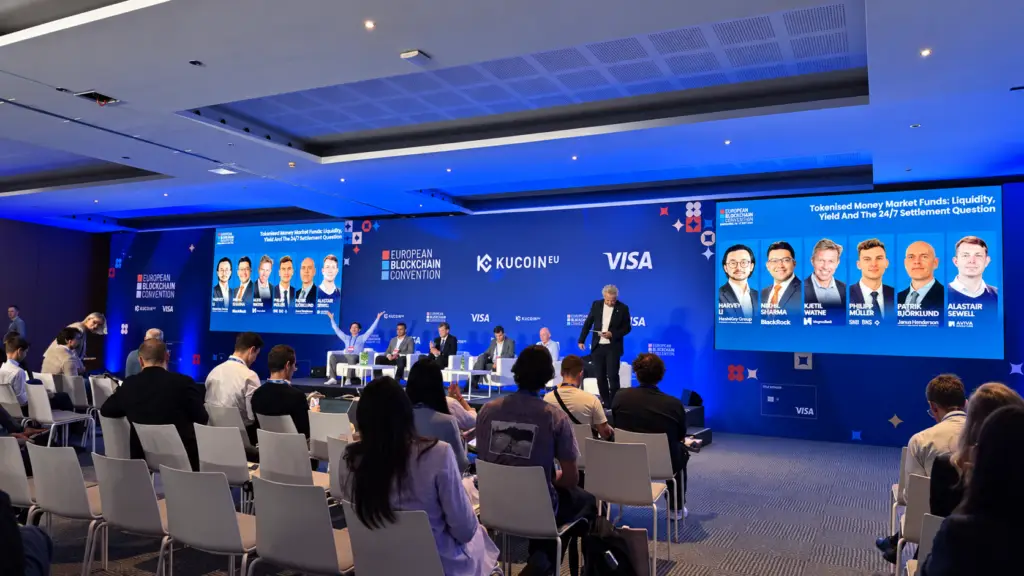
On 16 and 17 September 2026, AsianTrade Connect attended the European Blockchain Convention (EBC) in Barcelona, held at Palau de Congressos de Catalunya.
Now in its 12th edition, the European Blockchain Convention has developed into one of Europe’s main meeting points for the digital asset ecosystem, bringing together financial institutions, asset managers, investors, technology providers, regulators, infrastructure companies and emerging ventures. The 2026 edition brought together more than 6,000 attendees, 300+ speakers and participants from over 90 countries.
For AsianTrade Connect, participating in EBC represented an opportunity to look beyond blockchain as a technology in isolation and understand how digital assets are increasingly becoming connected with payments, financial infrastructure, capital markets and international business.
Across the two days, discussions involved representatives from institutions including BlackRock, Citi, BNP Paribas, Fidelity International, ING, LSEG, Swiss National Bank, UniCredit, Intesa Sanpaolo and the Bank of England, alongside technology companies, investors and digital-asset specialists. The direction of the conversation was clear: the industry is increasingly moving from experimentation toward questions of implementation, institutional adoption and commercial viability.
One of the most relevant developments observed during the event was the continued convergence between traditional finance and the digital-asset ecosystem.
The discussion is no longer limited to cryptocurrencies or decentralised applications. Banks, asset managers, financial institutions and infrastructure providers are increasingly exploring how blockchain-based systems can support areas such as tokenised financial products, settlement, custody, payments, fund distribution and asset management.
The official EBC agenda reflected this transition, with sessions dedicated to institutional capital allocation, on-chain asset management, tokenised assets, stablecoins, central bank digital currencies and the evolution of global payment infrastructure.
This evolution is particularly relevant because adoption ultimately depends less on the technology itself than on its ability to integrate into existing financial and commercial processes.
For AsianTrade Connect, one of the most relevant areas was the development of cross-border payment and settlement infrastructure.
Companies operating internationally still face several layers of complexity when moving money between markets: correspondent banking structures, settlement delays, currency conversion costs, compliance requirements and fragmented payment systems.
Stablecoins, tokenised deposits, digital currencies and blockchain-based settlement infrastructure are therefore increasingly being examined as potential components of the next generation of international payments.
At EBC, the relationship between stablecoins, CBDCs and global payment systems represented one of the core areas of discussion, together with the question of how regulated digital money could interact with the traditional banking system.
For companies operating between Europe and Asia-Pacific, these developments are particularly relevant. Markets such as Singapore and Hong Kong are already playing important roles in the development of digital-asset regulation and financial infrastructure, while European companies are operating within an increasingly structured regulatory environment.
The result is a financial ecosystem where technological innovation and international expansion are becoming progressively more interconnected.
Another recurring theme throughout the event was regulation. As digital assets become more closely integrated with mainstream financial services, questions around licensing, custody, compliance, financial crime prevention and investor protection are becoming central to commercial development.
The EBC programme specifically examined regulatory and market structures across jurisdictions including the European Union, United Kingdom, United States, UAE, Singapore and Hong Kong, reflecting the increasingly international nature of the discussion.
A product may be technically scalable, but its commercial model still needs to be adapted to different regulatory environments. The same technology may therefore require different partnerships, compliance structures and market-entry approaches depending on the jurisdiction.
This makes regulation not simply a legal consideration, but increasingly part of market strategy.
The presence of banks, asset managers, financial infrastructure operators and institutional investors also highlighted another important shift. The development of digital assets is increasingly being shaped by established financial institutions rather than exclusively by crypto-native companies.
EBC itself positioned institutional participation at the centre of the 2026 edition, with dedicated formats for asset managers, financial institutions, allocators and investors evaluating digital-asset exposure and infrastructure.
This changes the commercial environment considerably. Companies operating in the sector are increasingly expected to demonstrate not only technological capability, but also regulatory readiness, security, interoperability and a clear institutional use case.
The more difficult challenge is often identifying the institutions that genuinely have a need for that solution, understanding their internal requirements and building a proposition capable of progressing from an initial conversation to an actual commercial implementation.
As with the international trade fairs and industry events we regularly attend, the value of the European Blockchain Convention extended well beyond the conference programme itself.
The event combined panels and technical discussions with one-to-one meetings, networking formats, private roundtables, investor-focused sessions and startup presentations, creating multiple opportunities for companies, institutions and investors to interact directly.
For our team, this direct interaction remains particularly valuable. Market reports and industry data can help explain how a sector is evolving, but conversations with companies operating directly within that market often provide a different level of insight.
They help identify where organisations are actively investing, what problems remain unresolved, which technologies institutions are willing to evaluate and — perhaps most importantly — where commercial adoption is actually taking place.
One of the broader conclusions from Barcelona is that the next phase of blockchain and digital assets will likely be defined less by technological novelty and more by execution.
Technology needs to solve identifiable business problems. Financial institutions need solutions that can operate within existing regulatory and operational frameworks.
And technology providers need a clear understanding of which markets, institutions and partners are realistically positioned to adopt their solutions.
This is particularly important when international expansion is involved. Entering a new market requires more than identifying potential customers. It requires understanding the local financial ecosystem, regulatory structure, relevant decision-makers and the commercial incentives that determine whether a partnership can actually move forward.
We would like to thank the European Blockchain Convention and its organising team for bringing together such a diverse group of financial institutions, technology companies, investors and industry professionals in Barcelona.
We also thank the companies and professionals with whom we had the opportunity to exchange ideas and discuss potential areas of collaboration during the event.
For AsianTrade Connect, participating in EBC offered another perspective on how technology, financial infrastructure and international business are increasingly converging.
As companies continue to operate across more interconnected markets, understanding these developments will become increasingly important — not only for the financial sector itself, but for any organisation involved in cross-border commerce, payments and international expansion.

Collaborator of the SE Asia IP SME Helpdesk (European Commission)
.
Member and Technical Partner of Thai-Italian Chamber of Commerce
Member of Thai-Italian Chamber of Commerce